This studio-based module focuses on prototyping, evaluation, and refinement of design for animation, improving design ideas through practice and collaboration.
Design is a process that is iterative and is never fully completed. Appropriate development of design strategy and project management allows for the effective project conclusion, while also giving opportunity to forecast future iterations and growth.
Students learn to recommend, defend, and implement design concepts that are technically feasible and appropriate for a given target audience. Usability and accessibility are key design drivers, students will inform their practice through directly witnessing and experiencing aspects of behaviour in the real world as a way of inspiring and informing design decisions.
On completion, students will refine their understanding of the creative and technical requirements of design for animation within a team-based context preparing them to progress confidently to more complex issues. Team development and signposting will increase student awareness of their combined strengths and how they will shape their future.
- Teacher: Brian Morris
This module build on themes introduced at Level 4 and further develops knowledge of contemporary issues that challenge and influence the fields of animation. This is accomplished through a series of lectures and specific case studies, engaging with topics of commercial and experimental animation film, international and regional styles, relationship between animation and other art forms. It also offers an introduction to the main concepts in animation theory, and to new areas of study such as animation as non-storytelling, animated reality, postmodernism in animation, and gender and race in animation.
Seminars are used to further develop more advanced research, writing, and presentation skills. Individual and group discussions facilitate debates and the articulation of issues covers during the lecture series subject looking at how the influences of different practice areas can inform and influence one another.
This module also introduces students to methodological issues involved in the actual practice of carrying out research projects on the topics. Students not only learn about the various approaches and themes within animation studies, they also gain the study skills necessary to conduct their own research in a professional and time-effective manner.
- Teacher: Yannis Texis
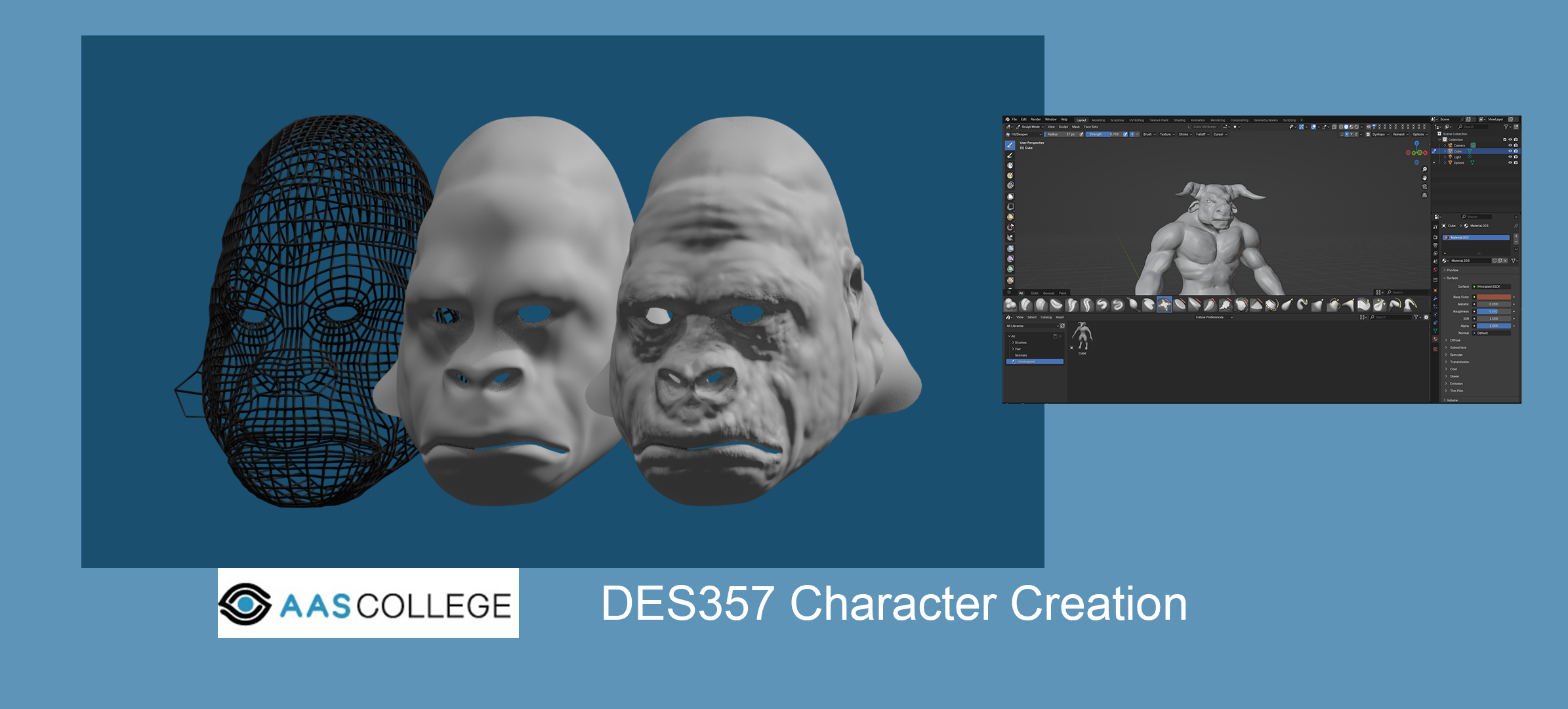
Whether it's for games, VFX, or Animation, characters are the main driving force behind establishing an effective connection between the audience and the story. While the character's animation and performance are crucial elements in conveying the narrative to the audience and triggering emotional responses, the character's design also features parameters that need to be considered in its development to a believable standard. These include an in-depth understanding of silhouettes, shapes, anatomy, high and low frequency detail, and a strategic approach to the pipeline. To complement the character animation content delivered in the 40-credit module DES 334, this module aims at introducing student to the principles, parameters, and pipelines in developing believable characters for Animation, VFX, and Games.
This module is 30 credits, as to be equal in importance and weighting to DES344 Animation Strategies which runs alongside the module in semester 1, both of which are practical focused studio modules.
- Teacher: Kostas Andrias
Because of the introductory nature of this module, it will be assumed that you have little or no prior knowledge of the role, responsibility and language of the preproduction process. This module investigates the skills required to proceed through the preproduction process.
This module will show the entire process of pre-production, from developing original and engaging ideas, concepting characters and environments to storyboarding and producing eye catching presentation material. You will examine potential audiences and how to market your ideas in a way that makes them appealing both to the public and industry alike.
In this course you will follow the preproduction pipeline for creating either a pitch bible for a children’s tv series or a game design document for a 7-PEGI game, from visual and contextual research through to concept art, story art, character design, environments, assets, linear and non-linear storytelling. Create an animatic or walkthrough to demonstrate your concept’s viability. Pitch your idea in a short presentation at the end of the module. Work individually, or as part of a creative team.
- Teacher: Brian Morris
Students will be expected to participate in the following:
Produce a collection of 3D Digital Animations culminating in an interactive playable character.
Produce a 3D digitally sculpted model and environment.
Develop and research ideas and the animation and games industry, which will be presented as research and developmental work.
- Teacher: Brian Morris
Because of the introductory nature of this module, it will be assumed that you have little or no prior knowledge of the role, responsibility and language of the preproduction process. This module investigates the skills required to proceed through the preproduction process.
This module will show the entire process of pre-production, from developing original and engaging ideas, concepting characters and environments to storyboarding and producing eye catching presentation material. You will examine potential audiences and how to market your ideas in a way that makes them appealing both to the public and industry alike.
In this course you will follow the preproduction pipeline for creating either a pitch bible for a children’s tv series or a game design document for a 7-PEGI game, from visual and contextual research through to concept art, story art, character design, environments, assets, linear and non-linear storytelling. Create an animatic or walkthrough to demonstrate your concept’s viability. Pitch your idea in a short presentation at the end of the module. Work individually, or as part of a creative team.
- Teacher: Brian Morris
- Teacher: Yannis Texis
The Animation Strategies module considers the importance of understanding communication with a focus on team-based projects. Students will be encouraged to look at a wide range of possible outcomes in order to develop their ability to deal with design as an abstract concept where there is no single given or prescribed "solution". Outcomes may include animations, contemporary digital art, visual effects, live action compositing, research, and where appropriate the use of offline media. Students will develop an understanding of the importance of taking a holistic view of the subject area for developing and deploying strategies and creative problem solving that also involves a level of risk-taking and experimentation.
The module will help students develop the creative and technical requirements towards 2D and 3D animation and help develop individual interest areas between these mediums.
This module is 30 credits, as to be equal in importance and weighting to DES357 Character Creation which runs alongside the module in semester 1, both of which are practical focused studio modules.
- Teacher: Yannis Texis